
Specifications
Surface Treatments
Certifications
- ISO 9001 - 2015 Certified
- PED 2014/68/EC
- NACE MR0175/ISO 15156-2
- NORSOK M-650
- DFAR
- MERKBLATT AD 2000 W2/W7/W10
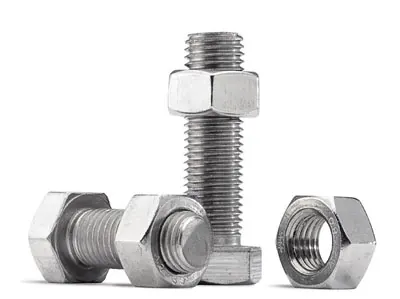
Nitronic 60 vs Nitronic 50 comparison for material selection. Both grades occupy the high-performance stainless / superalloy space; the choice depends on the controlling failure mode (galling vs corrosion vs strength) and the application service envelope. This page compares chemistry, mechanical properties, corrosion behavior, galling resistance per ASTM G98, cost, and the canonical use case for each grade. For Nitronic 60 specifications see UNS S21800; for the full Nitronic 60 portfolio see fasteners and bar.
TorqBolt stocks Nitronic 60 (UNS S21800) at our Mumbai head office and Rajkot production plant. Each consignment ships with EN 10204 3.1 mill test certification by default and 3.2 dual-witnessed inspection (Lloyds, TUV, DNV, BV) on request. Contact info@torqbolt.com or +91-22-66157017 for sized stock and lead time.
Nitronic 60 versus Nitronic 50 pair-wise comparison:
| Property | Nitronic 60 | Nitronic 50 |
|---|---|---|
| UNS | S21800 | S20910 |
| Yield (MPa) | 380 | 380 |
| Galling resistance | Excellent | Moderate |
| PREN | 18 | 36 |
| Cost (relative to 316L) | 2x | 2.5x |
| Cryogenic stability | To -196 C | varies |
| Best use case | Anti-galling is the dominant requirement | Pitting and crevice corrosion matter more than galling |
Cr 16-18 / Mn 7-9 / Ni 8-9 / Si 3.5-4.5 / N 0.08-0.18 / C ≤0.10. See full element ranges with single and aggregate limits →
Yield 55 ksi (380 MPa) min, tensile 95 ksi (655 MPa) min, elongation 35% min (annealed). Hardness Rockwell B95-95 typical. See full mechanical specification with bar / forging / wire conditions →
Nitronic 60 threshold stress 50,000 psi+ per ASTM G98 vs 304/316L at 4,000-6,000 psi — 5 to 10× better galling resistance. See full ASTM G98 data and galling failure mechanism →
Solution anneal only at 1900-1950°F followed by water quench. No precipitation hardening response. See full heat treatment specification →
Matching filler ER218 per AMS 5847. GTAW, GMAW, and SMAW all qualified. No PWHT required for typical thicknesses. See full welding procedure →
Nitronic 60 wins for anti-galling at high temperature where 304/316L gall. Stellite is harder but brittle. vs 316L · vs Nitronic 50 · austenitic context →
For Nitronic 60 stock for any application where Nitronic 50 is the alternative, Contact the TorqBolt QA-QC team at info@torqbolt.com or +91-22-66157017. We respond within 24 hours with sized stock availability, lead time, and EN 10204 3.1 / 3.2 MTC documentation samples.
When should I choose Nitronic 60 over Nitronic 50?
Choose Nitronic 60 when anti-galling is the dominant requirement. The high-Mn-Si-N chemistry provides anti-galling at a stainless price point.
When should I choose Nitronic 50 over Nitronic 60?
Choose Nitronic 50 when pitting and crevice corrosion matter more than galling. Each grade has a distinct service envelope where it outperforms.
Are Nitronic 60 and Nitronic 50 cross-substitutable in fasteners?
Sometimes, with engineering review. Different yield strengths, galling behavior, and corrosion envelopes change the joint design. Substitution requires confirming the controlling failure mode and re-running joint analysis.
Cost difference between Nitronic 60 and Nitronic 50?
Nitronic 60 is approximately 2x the cost of 316L. Nitronic 50 is approximately 2.5x versus 316L. Compare on a total-life-cycle basis including disassembly, service life, and replacement frequency, not just unit cost.