
Specifications
Surface Treatments
Certifications
- ISO 9001 - 2015 Certified
- PED 2014/68/EC
- NACE MR0175/ISO 15156-2
- NORSOK M-650
- DFAR
- MERKBLATT AD 2000 W2/W7/W10
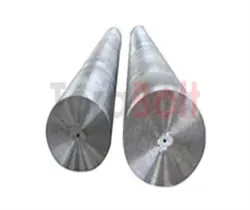
Nitronic 60 forging (UNS S21800) covers open-die and closed-die forgings for valve bodies, flanges, pump shafts, large heavy hex nuts, anchor bolts, and machined-from-forging anti-galling components. Forging stock is ordered per AMS 5848 (aerospace-quality bar and forging) or ASTM A314 (general industrial forging stock); finished forgings ship solution-annealed at 1010-1120 C with water quench, hardness 95 HRB max, yield 380 MPa min.
AMS 5848 covers Nitronic 60 (UNS S21800) bar and forging for aerospace and high-quality industrial use, with tighter chemistry and inclusion-rating limits. ASTM A314 covers stainless forging stock for general industrial service. Both reference the same UNS S21800 chemistry; AMS 5848 adds aerospace-grade non-metallic inclusion limits per ASTM E45. Order to AMS 5848 for any aerospace, nuclear, or NACE-critical forging; A314 is fine for general industrial.
Nitronic 60 forges in the temperature window 1095-1230 C (2000-2250 F). Drop work below 950 C (1740 F) leads to high flow stress and risk of cracking. The high silicon content forms a tenacious oxide layer that helps protect the workpiece during forging but requires more aggressive scale removal during finishing operations. Cool from forging temperature in air or to room temperature before solution anneal; air-cool from forging directly into solution anneal can be combined when production sequencing permits.
Standard post-forge treatment is solution anneal at 1010-1120 C (1850-2050 F) followed by water quench. Solution anneal redissolves any carbides or nitrides that precipitated during slow cooling from forging temperature, and locks the high-Mn-Si-N solid-solution chemistry in place. Hardness after solution anneal: 95 HRB max per AMS 5848 / ASTM A314. Do not age, Nitronic 60 is not precipitation-hardenable; an aging cycle achieves nothing and may risk sigma-phase precipitation if held too long in the 540-815 C range.
| Property | AMS 5848 / A314 Min | Typical |
|---|---|---|
| Tensile strength | 690 MPa (95 ksi) | 760 MPa (110 ksi) |
| Yield strength 0.2% | 380 MPa (55 ksi) | 430 MPa (62 ksi) |
| Elongation in 50 mm | 35% min | 50% |
| Reduction of area | 55% min | 65% |
| Hardness | 95 HRB max | 87-92 HRB |
Forgings ship with EN 10204 Type 3.2 MTC standard (independent third-party endorsement is the norm for forged pressure parts and API 6A trim). Test coupons are forged from the same heat under the same forging cycle and tested per AMS 5848 / ASTM A370. Heat-treatment time-temperature charts and grain-size determination per ASTM E112 supplied on request. UT inspection per ASTM A388 available for heavy forgings.
For Nitronic 60 open-die or closed-die forgings sized to spec, with AMS 5848 / ASTM A314 traceability and 3.2 MTC, Contact the TorqBolt QA-QC team at info@torqbolt.com or +91-22-66157017. We respond within 24 hours with sized stock availability, lead time, and 3.1 / 3.2 MTC documentation samples.
Should I order to AMS 5848 or ASTM A314?
AMS 5848 for aerospace, nuclear, NACE-critical, or any forging where ASTM E45 inclusion-rating limits are required. A314 for general industrial. Same UNS S21800 chemistry, same annealed mechanical minimums.
What forging temperature is recommended?
1095-1230 C (2000-2250 F). Drop work below 950 C (1740 F) leads to high flow stress and cracking risk. Cool to room temperature before solution anneal, or sequence directly into anneal where production permits.
Why is post-forge solution anneal required?
Slow cooling from forging temperature can precipitate carbides and nitrides at grain boundaries. Solution anneal at 1010-1120 C followed by water quench redissolves them and locks the solid-solution chemistry, restoring 95 HRB max hardness and full corrosion resistance.
What MTC is included for forgings?
EN 10204 Type 3.2 (third-party endorsement) is standard for forged pressure parts. Test coupons forged from the same heat under the same cycle, tested per AMS 5848 / ASTM A370.
Can Nitronic 60 forgings be aged for higher strength?
No. Nitronic 60 is not precipitation-hardenable. Aging achieves nothing and risks sigma-phase precipitation in the 540-815 C range. For higher proof load, use cold-worked bar or specify A193 Gr B8RA hot-strain-hardened.